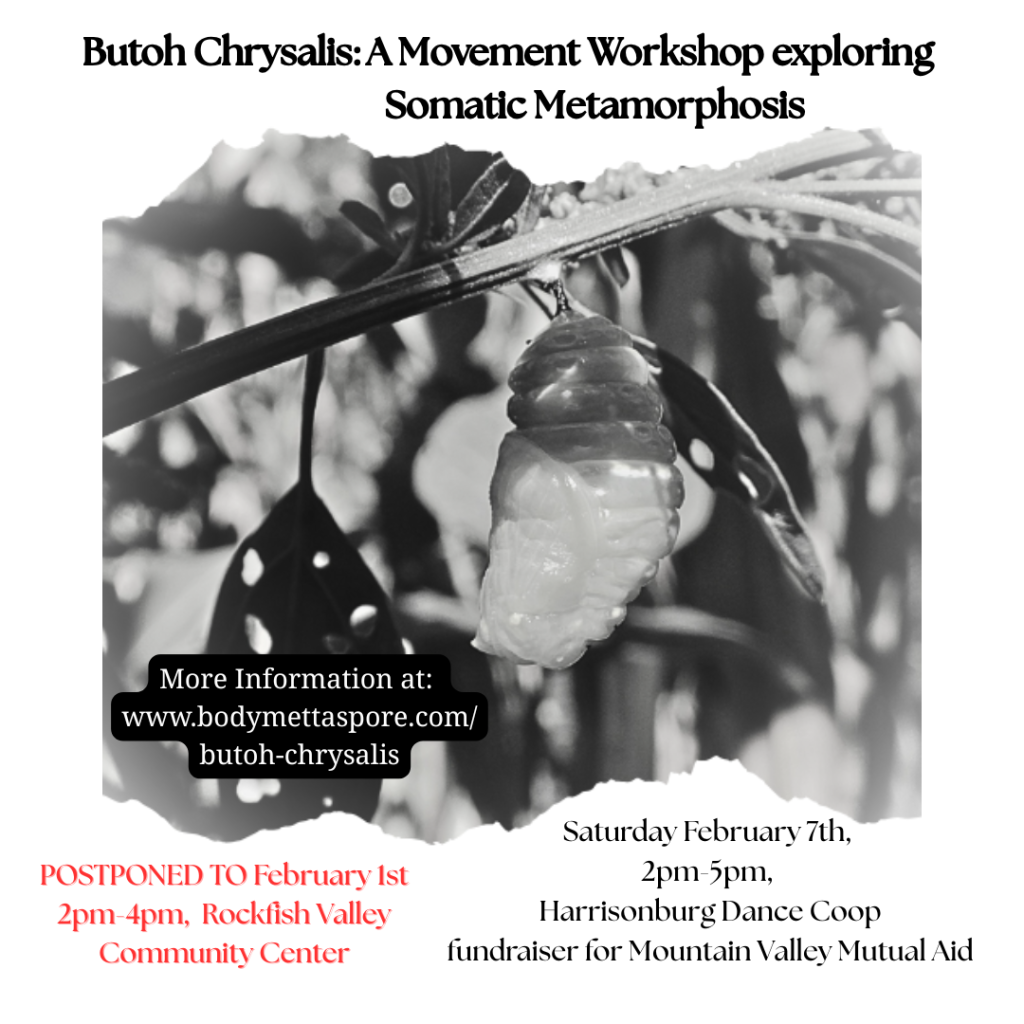
Butoh Chrysalis: A Movement Workshop Exploring Somatic Metamorphosis

NEW DATE: Sunday February 1st, 2pm-4pm, Rockfish Valley Community Center, $30 (maximum 12 participants, please register to reserve your spot) 

Saturday February 7th, 2pm-5pm, Harrisonburg Dance Coop (fundraiser for Mountain Valley Mutual Aid) suggested $35 but any donation amount is welcome and nobody turned away for lack of funds

Participants may attend one or both sessions as desired. They will be similar workshops, though the fundraiser event will be more in-depth and longer. 

Register here:

Butoh Chrysalis Registration

Butoh Chrysalis Registration Form 

More details below!

_________

We are in (yet soon to be nearing the end of) the time of winter dreaming. We are still in the chrysalis, individually and collectively. In the cloak of the disintegrating dark, dreaming in a liminal space, in the soup of possibility. Yet, the seasons turn towards spring and we are beckoned to soon emerge. Whether Imbolc, Chinese New Year, Maslenitsa/Pust, or other upcoming seasonal holy days, change is afoot. The intense auspices of the Year of the Fire Horse will call for courage as well as wisdom. What needs to transform at the level of the subconscious and bodily tissues to meet the call? 

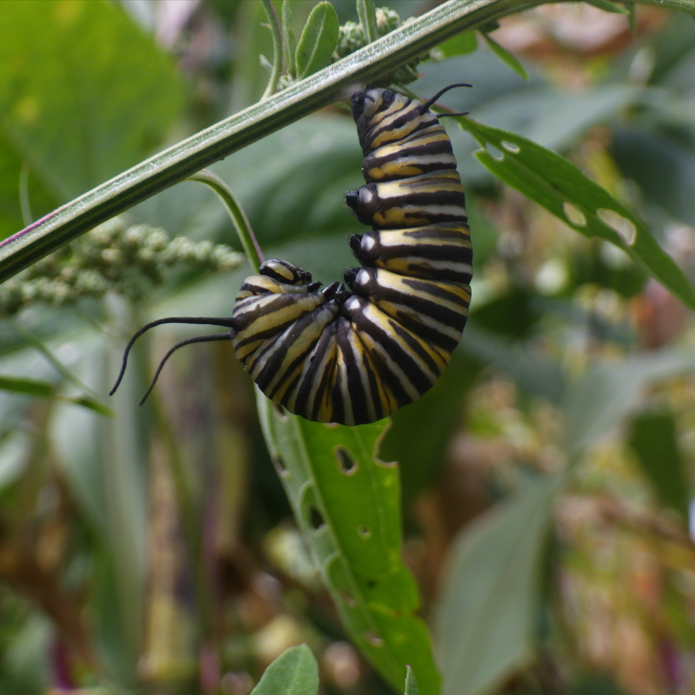
To transform, we disorganize to then re-organize, just like a caterpillar dissolves and rebuilds their organs (re-organizes) during metamorphosis. This is a kind of “somatic opening” to make space for change. This process occurs at the level of the tissues; in particular, the fascia matrix has a lot to do with how we habitually shape our bodies and minds. This class focuses on a metaphoric chrysalis as a place to unwind stuck, numb, or rigid tissues and patterns and to make possible other ways of being. The unwinding, “un-choreographing,” movement portion asks of you willingness to be in a space of slowness, witnessing what might be otherwise suppressed, hidden, subtle, taboo, rotting, “messy,” or just otherwise unacknowledged.  I provide some structured movement patterns that are likely to help you listen to what’s happening and emerging in the web of connective tissue, and give you several “ways in” to allowing improvisational movement to emerge from that perception. We learn to strengthen the muscle of trusting processes that are transforming within our bodies and lives, trusting that our “wings” are growing inside the chrysalid soup. We reinforce embodied pathways to finding a calm center within seeming chaos, as well as pathways towards play and dynamic responsiveness. 

After the unwinding, we make our way towards reintegration (knowing that larger patterns are still underway and many metamorphoses cannot find resolution within the span of one class). Yet, we can learn and rehearse how to nurture the emergence of new shapes and patterns in the body that can bring us into closer alignment with our values and commitments in the world. What is practiced in the class is a touchpoint, an anchor, a first draft, a body memory to guide further unfolding. 

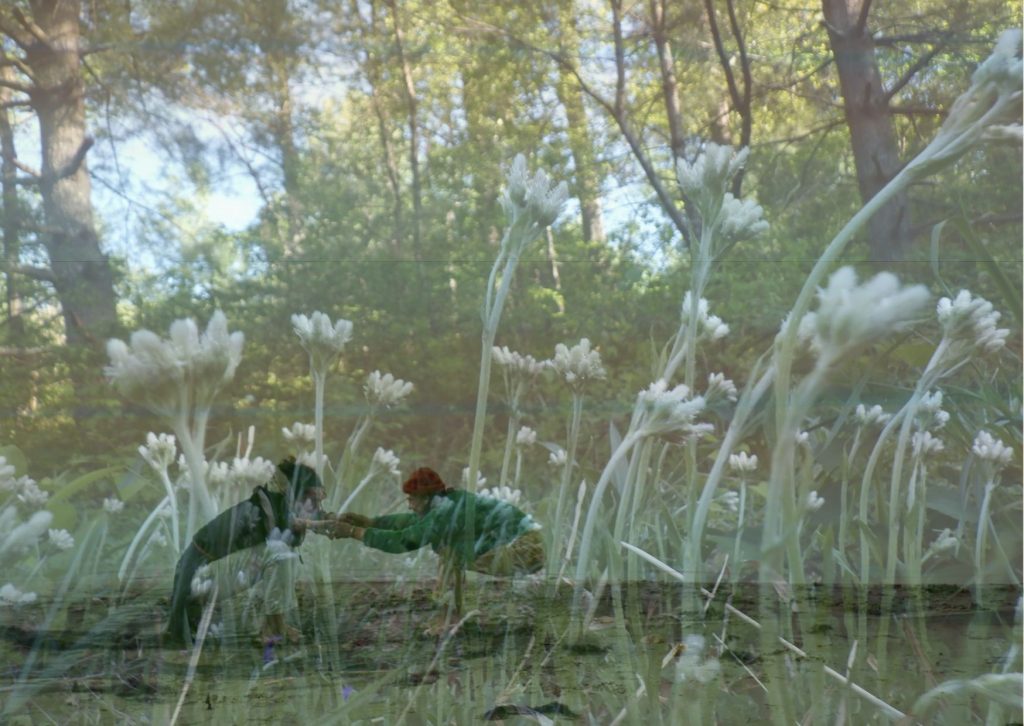
Participants can expect to be guided through movement practices and somatic invitations which structurally include moving on your own, as well as invitations (optional) for partner and group practices. There will be ample time allocated for nonverbal movement exploration (at times accompanied by music/sound) as well as some verbal time at different points to process what’s coming through the body if conversation is helpful for you. If weather permits, we will incorporate short durations of time outdoors to connect with the beings of the place and the patterns of the season. Regardless of outdoor time, participants will also be invited at different times to connect with non-human beings who might inform our deeper understanding of metamorphosis and the aspects that are most prominently showing up in our lives. 

Note on Context and Lineage of Practice: Some movement practices in this workshop are directly inspired by Butoh dance training and methodology. However, it is not *strictly* a Butoh workshop, but rather more broadly a somatic movement workshop. Please see the “About Me” page of my website to learn more about the constellation of specific teachers and techniques that inform and ground my approach, which synthesizes several different lineages. No dance experience is necessary, but a willingness to get curious about your body and engage in improvisational as well as lightly choreographed movement in the presence of others is needed. Don’t hesitate to reach out if you have any questions- you can email me at victoria.maria012@gmail.com

“Human fascia is a continuous and ubiquitous three-dimensional web of pre-tensioned connective tissue permeating and supporting every cell, tissue, and organ of the body, providing structural integrity and tensional balance…Fascia is not a passive container but a dynamic complex tissue constantly remodeling in response to mechanical and biochemical stimuli, modulating muscle function, bone health, fluidic dynamics, joint stability, posture, pain, interoception, and proprioception. Moreover, fascia plays a crucial role in intercellular communication, emotions, immune defense, and inflammation regulation.” -John Sharkey and Mark Flannigan, “Towards a Paramedical Interdisciplinary Definition of Fascia Supporting Practitioners Offering Fascia-Focused Therapies” 

“First, the caterpillar digests itself, releasing enzymes to dissolve all of its tissues. If you were to cut open a cocoon or chrysalis at just the right time, caterpillar soup would ooze out. But the contents of the pupa are not entirely an amorphous mess. Certain highly organized groups of cells known as imaginal discs survive the digestive process. Before hatching, when a caterpillar is still developing inside its egg, it grows an imaginal disc for each of the adult body parts it will need as a mature butterfly or moth—discs for its eyes, for its wings, its legs and so on. In some species, these imaginal discs remain dormant throughout the caterpillar’s life; in other species, the discs begin to take the shape of adult body parts even before the caterpillar forms a chrysalis or cocoon. Some caterpillars walk around with tiny rudimentary wings tucked inside their bodies, though you would never know it by looking at them…Once a caterpillar has disintegrated all of its tissues except for the imaginal discs, those discs use the protein-rich soup all around them to fuel the rapid cell division required to form the wings, antennae, legs, eyes, genitals and all the other features of an adult butterfly or moth.” -Ferris Jabr, “How Does a Caterpillar Turn into a Butterfly?”
Shift Witness: Art Installation, Dialogue, and Workshops Exploring Relationships with the South River

On display at Hunt Gallery at Mary Baldwin University from October 27th through December 5th, 2025: https://marybaldwin.edu/hunt-gallery

with interactive events happening on October 30th, November 14th, November 15th, and December 6th. See below poster for more details.

Shift Witness is a collaborative installation created and coordinated by Jordan Fust, Shoz Frantz, M Greenwald, Taylor Hanigosky, Anne Hopestill Kappers, and Victoria Moyer. There are a variety of events that accompany the show both in the gallery space and at the South River in Waynesboro, VA. 

The installation and participatory events reflect an ongoing process of embodied research and ritual alongside “Loth” Spring and the South River. Our processes incorporate dance, fiber arts, sound, and other modalities. The collected images, writing, video fragments, found ephemera, textiles, ritual craft objects, and guided workshops engage with a set of questions around disturbance ecology, animate landscapes, non-linear mythology, and shifting patterns of relationships. 

The South River has been the site of major industrial pollution, which if you aren’t already familiar with, you’ll learn more about as you flip through some of the zines we made or take a walk by the river and read the informational plaques…

there is no easy way to sum up the complicated history of the South River, the spring-fed tributaries, and the shifting assemblages of inhabitants and participants, but we can say that our intention is to honor the complexity of interwoven stories and to promote a spirit of reverent, respectful, even devotional relationship with the river, springs, and land. We have been called to work with this place, but all places are alive and sacred in their own way. Like dormant seeds, we seek to open cracks in the concrete slabs of extractive modes that we’ve been raised in when it comes to relating to place.

Panel, Workshops, and Performance Details Below

link to download poster if not visible on mobile device:

Text from the poster with all event dates and more info:

Opening Reception: October 30th, 4:30-6:00pm; Hunt Gallery; Artist Talk at 5:15pm

Panel Dialogue: November 14th, 6:00-7:30pm; Hunt Gallery (Mary Baldwin University)

Topic: “Histories and Futures of People-Place Relationships at the South River” with Featured Guests:

Victoria Ferguson: Victoria Persinger Ferguson is an enrolled citizen of the Monacan Indian Nation and is a graduate of Marshall University. She has 30 years background in researching science methodologies and historical documentation on the daily living habits of the Eastern Siouan populations up through the early European colonization period. Victoria has been involved with public history as a historical interpreter for over 25 years and participated in educational documentaries. She serves in the position of Program Director for Solitude/Fraction on the campus of Virginia Tech and is the Presidential Ambassador to Native Nations.

Mary Katharine Froehlich: Mary Katharine is a passionate community organizer and an advocate for connection between the South River Watershed and all of its inhabitants. She is perhaps best known as the founder and co-owner of Stone Soup Books, where she inspires critical dialogue with regional authors, place-based stories, and environmentally-engaged issues. Mary Katherine serves on local boards such as South River Watershed Coalition.

Meghan Williamson: Meghan Williamson’s work supporting grassroots, non-profit, and municipal projects of land and community connection take her up and down the Shenandoah Valley. She serves as a professional writer, consultant, and editor within many valley-based organizations and acts as a connective tissue among folks involved in local food systems, bicycle coalitions, land stewardship projects, and timberframing guilds.

Plus other local community members!

Liminal Plant Walk and Movement Workshops: November 15th, 1-4:30pm; Loth Springs Natural Area (600 Race Ave, Waynesboro)

Plant Walk 1pm-2:30pm, Movement Workshop 2:45pm-4:30pm

In the plant walk, we will meet plants who are both alive and dead, whose seeds prepare for the next generations while other vegetative parts die back. We’ll learn about the plant communities making a home in a landscape marked by disturbance and flux. In the movement workshop, we’ll take the connection methods into a more somatic realm and present dance-adjacent prompts & practices that reflect the processes our group works with. Participants can attend one or both sessions. Donations appreciated but not required.

Participatory Closing Performance: December 6th, 5pm; South River Greenway (Meet at 101 Short St)

“Grief Parade” is an interactive processional performance/ritual to engage with the interwoven threads of personal and collective memory, grief, and love, rooted in connection to the South River. Participants who would like to walk a 1/2 mile portion of the Greenway and engage with facilitated prompts by the artists are welcome to meet at the new South River Preserve Parking Lot (101 Short St) at 5pm for brief instructions. Participants who would like to witness/receive the procession are invited to gather at 5:30 at the procession’s destination at Loth Spring (Parking on Arch st, past the intersection with 14th). Costumes, masks, and dress are welcome in ways that convey reverence for the river and the interconnectedness of grief and watersheds. 

e-mail victoria.maria012@gmail.com with any questions!


Artist-made zines/booklets. Each member of our collective contributed to writing, compiling, and designing a small booklet that dives deeper into an intersecting theme of this project. The zines feature poetry, plant surveys, stories, and place-based research into fiber history, geology, and myth.  Set of 7 titles. Available in the gallery to be read freely, or available for purchase to read on your own. If you would like to purchase, we suggest $10 per individual booklet, or $50 for the full set of artist-made booklets. Send inquiries to thornypioneer@gmail.com or pickup/donate in the gallery space or at one of our events where we will have the sets available.
Titles include:

Breath and Poetry for the South River; The Dancers of a Growing Disorder; The Stories the Flora Tell: Plant Patterns at the South River and Loth Springs; Where Water Meets Rock Meets Bodies: Katabasis; About the Spring I Visit; A Grief Parade; After Pyrite Over Coal: Rayon in Waynesboro